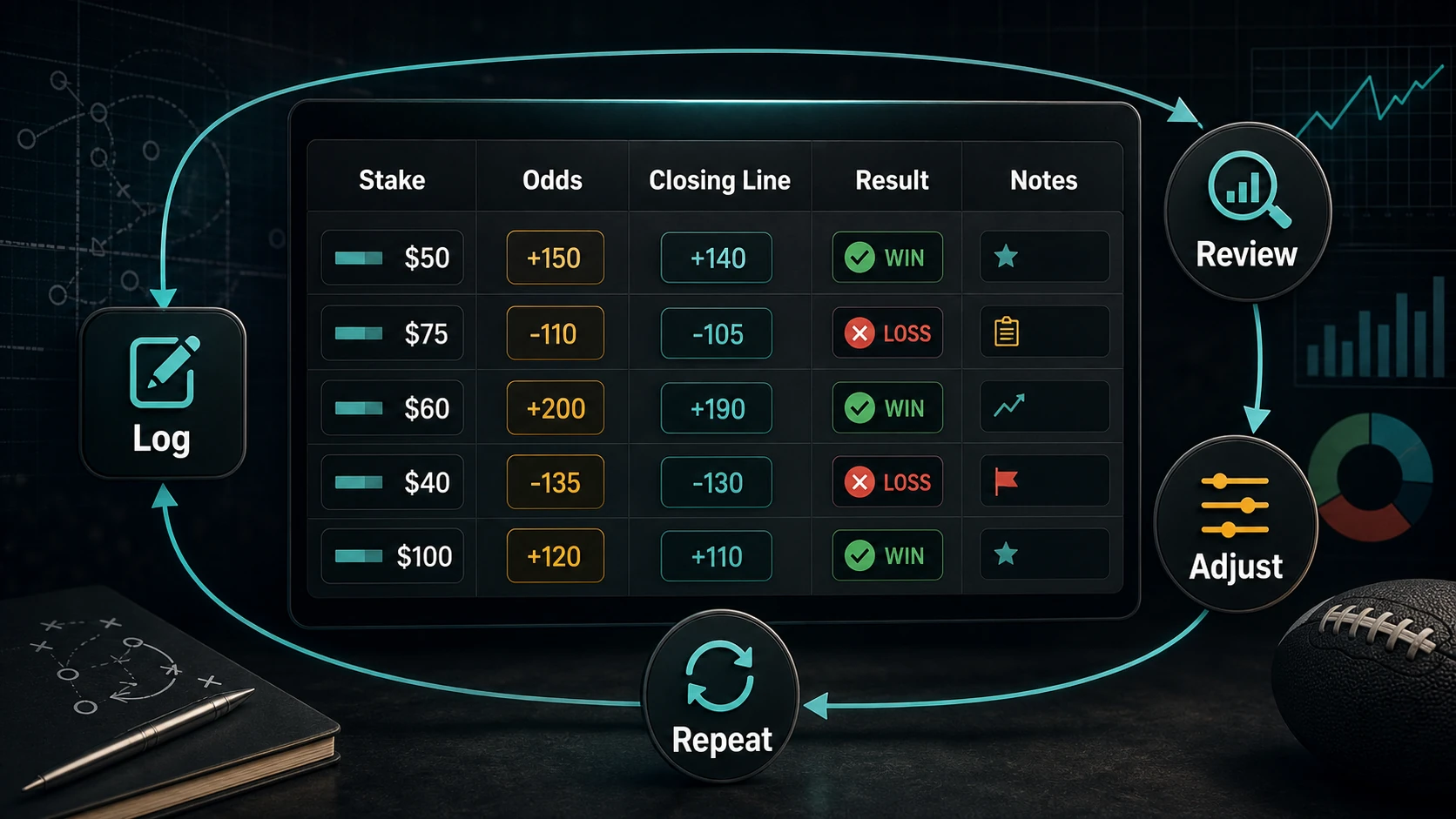
A betting log records the ticket you accepted, the reason for the bet, and what happened after the market moved or the bet settled. Without those fields, postgame review turns into memory instead of evidence.
Capture the ticket before the game starts
The accepted ticket is the primary record. Save the event, market, selection, line, price, sportsbook, execution timestamp, stake, and settlement terms exactly as shown. A spread is not interchangeable with a moneyline, and regulation-only settlement is not the same contract as full-game settlement. A listed pitcher, starting goalie, or player-participation rule can change whether a wager stands.
Record the reason for the bet separately from the ticket. Name the model, manual read, or source that produced the decision, then keep the note short enough to audit later: injury assumption, weather input, lineup expectation, or price discrepancy. “Felt good” leaves no useful case to review.
The structure in the closing-line-value guide starts with this discipline. You cannot compare execution with the close when the original execution price is missing or reconstructed.
Use fields that make bad records obvious
A clean spreadsheet separates facts from derived fields. Facts come from the ticket or settlement record. Derived fields come from formulas you can inspect. Do not type a result into several places and hope they stay synchronized.
- Ticket fields: event, market, selection, line, price, book, accepted time, stake, and ticket identifier.
- Context fields: sport, competition, model or reason for the bet, expected lineup, and any rule that affects settlement.
- Market fields: closing line, closing price, close timestamp, and the source used for that close.
- Settlement fields: open, won, lost, pushed, voided, or disputed, plus the official settlement timestamp.
Those settlement states should be mutually exclusive. A disputed ticket is not a loss just because cash has not arrived, and a void is not a push. An open wager does not belong in a graded record. One explicit status per row makes contradictory states harder to create.
Report records with their denominator attached
The honest result line for ATS picks contains wins, losses, win rate, window, and graded sample size. Pushes and voids sit beside the record instead of disappearing into the denominator. The window can be a named season, a date range, or another fixed period, but it cannot be “recent” unless recent is defined before the results are read.
Do not convert that record into a universal claim. A short winning run can be real and still say almost nothing about the next wager. Break the log into categories only when the category was recorded at bet time. Slicing after the fact until one corner looks good is not discovery; it is a search for flattering noise.
When there are no settled rows, say so: no graded picks yet for the selected window. That empty state is more useful than a demo table because it preserves the difference between the product’s history and a sales example.
Closing-line review starts with record quality
Closing-line value can help separate price capture from final-score luck, but only under matching definitions. Compare the same market, side, settlement rule, and price format. A close copied from another book can be useful context, but label it as a different source. A stale screenshot is not a close merely because it was taken later.
Review misses before celebrating beats. Mark an absent close unavailable; when books disagree, record the source or a documented consensus method. For a line repriced after a roster change, note whether your ticket preceded the information. Preserve what happened instead of forcing every row into one metric.
Separate process review from bankroll emotion
After settlement, verify the row and stop. Do not let one win excuse a bad price or one loss erase a sound process. The broader review belongs on a fixed schedule with enough rows to inspect recurring behavior: late entries, missing injury checks, duplicated markets, correlated exposure, or bets placed outside the model’s stated scope.
That review should connect to bankroll management basics, but the ledger and the bankroll are not the same thing. The ledger records what happened. The bankroll policy decides what exposure was allowed. Mixing them encourages retrospective excuses.
Build for correction, not decoration
A useful tracker makes edits visible. Keep the original ticket evidence, note corrections, and avoid overwriting a settled row without an audit note. If a book changes settlement, preserve both states and the reason. If you discover an entry error, correct the field and record the correction rather than quietly rewriting history.
You can compare current selections on the picks page and review model output on the desk, but the log still needs to stand on its own. The test is simple: months later, can another person reconstruct the decision from the row without asking what you meant?
Track to make yourself harder to fool. A complete row can expose a bad habit. An incomplete row can only preserve a mood.
NFL ATS cover-margin distribution
Bars count completed NFL schedule rows by closing-spread cover margin using the repository canonical home-margin grading convention.