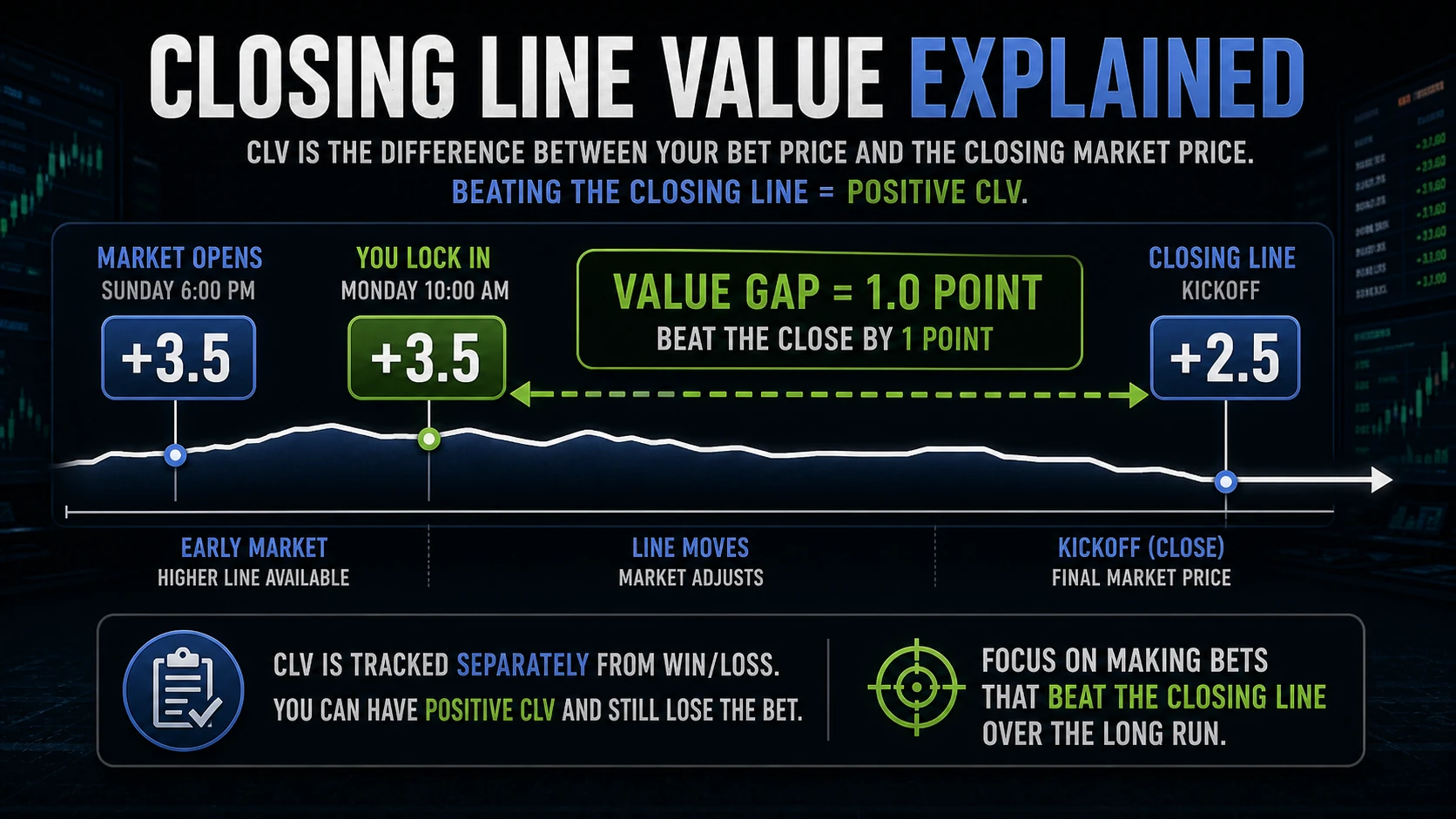
Closing line value compares the price you accepted with a defined closing reference for the same market. It helps separate price-taking discipline from the final score, but it does not replace the graded result.
That makes CLV useful for one reason: it judges the decision before the final score starts rewriting your memory. A good bet can lose. A bad price can win. Your log needs room for both truths.
CLV is a comparison, not a trophy
Closing line value compares the terms you actually accepted with a closing reference for the same market. A better entry is positive, a worse entry is negative, and a mismatch between markets makes the comparison invalid.
The phrase “same market” does a lot of work. A full-game spread is not a first-half spread. A player threshold at one number is not interchangeable with a different threshold just because both concern the same player. A price captured before a rule change belongs to a different contract from a market closed under the new rule.
CLV is therefore only as clean as the log beneath it. The calculation is easy. The matching is where bettors quietly cheat themselves.
Record the accepted ticket first
Start with the wager confirmation, not the number you remember seeing. Markets move between click and acceptance. Repricing prompts happen. A stale screen can survive long enough to lodge the wrong entry in your head.
Log the event, market, selection, line or threshold, accepted price, venue, and acceptance time. Attach the model or decision rule that produced the bet. That record is the entry side of the comparison and should never be overwritten after the game.
The operational checklist in the bet-tracking guide is less glamorous than a heater screenshot. It is also the part that makes every later conclusion possible.
Choose the close before seeing the result
A bettor can manufacture flattering CLV by changing the benchmark after the fact. One book closes in your favor, another does not, so the winner gets whichever reference looks best. That is not analysis. It is souvenir shopping.
Write the closing-source rule before the season or before the strategy begins. The rule can use a designated market maker, a defined consensus, or another source your workflow captures consistently. What matters is that the choice is stable and auditable.
When the reference is missing, stale, or incomparable, mark CLV unavailable. An unavailable value is honest; a convenient substitute is not.
Compare like with like
Spread CLV can involve both the number and the attached price. Moneyline CLV is easiest to compare in implied-probability space after applying one consistent vig-removal method. For props, match player, direction, threshold, rules, and close time before comparing prices.
Do not flatten all of those markets into one unlabeled average. Keep the sport, market family, venue, and closing source beside each observation. A pooled number can hide that one slice is well recorded while another is mostly unmatched noise.
The guide to vig and hold covers why raw sportsbook prices cannot always be compared without first removing the book’s margin. Pick one method, document it, and do not switch methods when a different answer looks nicer.
CLV and record answer different questions
Record asks whether the wager won, lost, pushed, or voided. CLV asks whether the entry beat a later market reference. Neither question replaces the other.
Poor results during a positive CLV run can reflect sound price-taking, a noisy sample, a weak closing reference, or a market move your process did not explain. Good results alongside negative CLV can come from luck, a noisy close, or a strategy the chosen benchmark misses. CLV narrows the investigation; it does not finish it.
This is why the loud claim “positive CLV means you are definitely sharp” belongs in the trash. The honest claim is narrower: consistent, well-matched CLV is evidence about execution quality. The strength of that evidence depends on the market and the sample.
Use windows and samples, not vibes
Every reported record needs a window and a sample count. The same discipline applies to CLV. “I beat the close” is not a result. Name the dates, market family, eligible wagers, matched wagers, and missing records.
Review missingness before the average. If losing tickets are harder to match, or one venue drops closing prices, the surviving set can look better than the full process. A complete ugly sample is more useful than a polished fraction chosen by accident.
Keep settlement and CLV as separate columns in the bettor desk or your own log. That prevents a bad Sunday from editing the entry and stops a lucky win from upgrading a poor price.
What to do when CLV turns against you
Do not immediately rewrite the model. First check the boring failures: wrong market mapping, wrong side, stale timestamp, mismatched close, and missing price. Then split the result by venue, market, and decision timing.
If the records are clean and one slice repeatedly closes against you, inspect the process that creates that slice. Acting too late, using stale information, comparing against the wrong market, or trusting a model that fails against the closing price are concrete places to check.
The fix can be narrower than “stop betting.” Drop the broken market, change the capture rule, or move the model back to research. The point of a diagnostic is to tell you where to cut.
Bottom line
CLV preserves the price story that the final score tries to erase. Record the accepted ticket, define the close in advance, and match the exact market. Report the window, sample, and missing rows, then read CLV beside the graded record.
That habit will not make every bet good. It will make bad process harder to hide, which is the closest thing betting has to a durable edge.