A trade analyzer is not an oracle. It is a projection comparison wrapped around a roster model. When two tools disagree, the useful question is not which logo is smarter. It is which assumptions differ, and which set better matches your league.
The verdict begins with projections
Every player value starts with expected usage and scoring. If the projection is stale, the trade result is stale. Check whether the tool has absorbed recent snap share, routes, targets, injuries, quarterback changes, and role competition. A clean equation cannot rescue bad inputs.
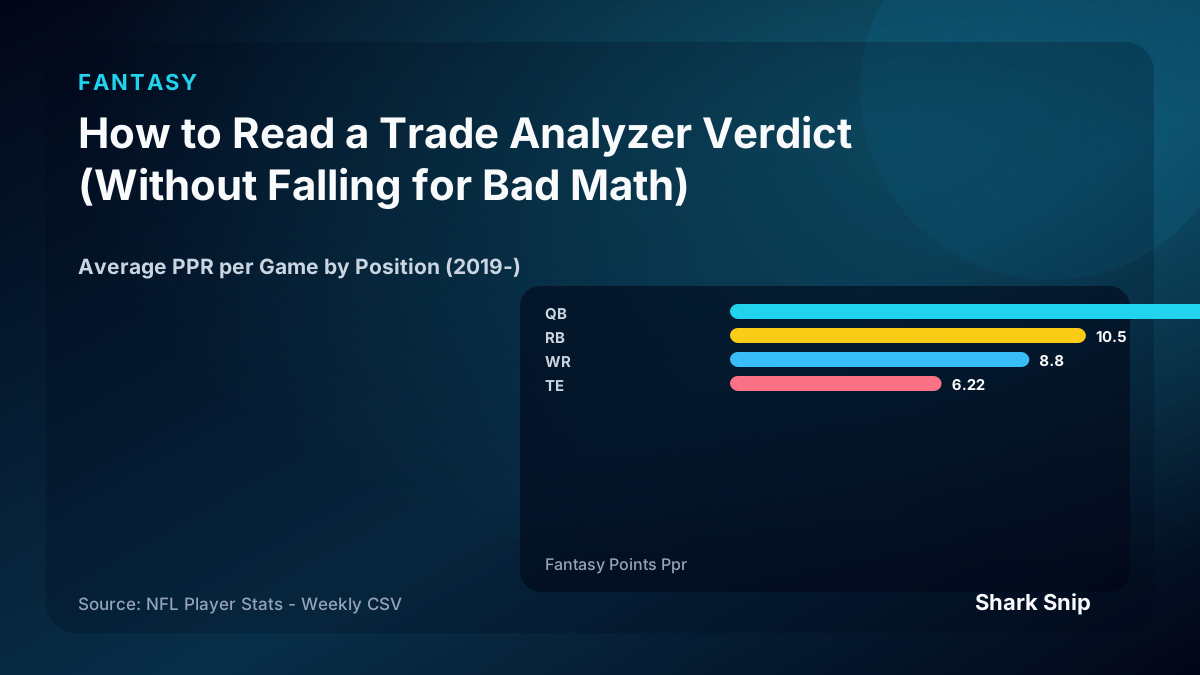
The chart above supplies a historical position baseline from weekly player stats. That baseline helps frame replacement level. It is not an individual price list. A receiver with an unusual role should not be forced toward a generic position average simply because the chart is tidy.
The time window changes the answer
“Rest of season” sounds objective, but it can hide what your roster actually needs. A team fighting to stay alive values the next usable starts differently from a team that can plan around later matchups. Bye weeks and existing depth matter because a projected point has value only when it enters your lineup.
A good analyzer should expose the window and let you change it. A bad one rolls every remaining week into one number, then presents the result with false certainty. The cure is simple: inspect the near-term schedule, the likely playoff path, and the weeks in which each player would start for you.
Replacement level is the hidden player in every trade
Package deals are where analyzers most often fool managers. When you send away multiple starters for one stronger player, the empty lineup slot does not disappear. It is filled by a bench player or a waiver claim. The value of that replacement belongs in the trade.
Use the player your roster would actually start, not an abstract league-average replacement. Shallow benches can make consolidation trades attractive because useful production remains available. Deep benches can make the same deal painful because the final starting slot falls to a weak option. The FAAB strategy guide helps price that replacement path.
Roster fit can outrank raw totals
A trade that adds projected points to your bench may not improve your weekly lineup. A slightly smaller projection can be more valuable when it fixes a weak starting slot, covers a bye, or reduces dependence on one fragile role. Conversely, acquiring a famous player at a position where you already have depth can make the team look richer without making it better.
Before accepting a verdict, write the lineup before and after the trade. Name every starter, the first replacement, and the roster spot you would cut. If the tool cannot represent that change, treat its number as a rough input rather than the decision.
Uncertainty needs its own line
Injury returns, rookie role changes, and new coaching usage are not ordinary projection problems. The range of plausible outcomes is wider. A single point estimate hides that uncertainty and makes close trades look settled.
Mark what could change the call. A restored route role may justify buying before the box score catches up. A workload cap may make the same player untradeable at the current price. For receivers, the target share and air-yards guide gives a cleaner way to inspect whether the role is recovering.
Read the verdict as an argument
The strongest tools show their work: projection source, scoring settings, time window, replacement player, and uncertainty. Those inputs let you disagree productively. A verdict that only says “win” or “lose” asks you to trust a hidden chain of assumptions.
- Check the data date. Make sure the role evidence is current.
- Check the scoring. Confirm the tool matches your league.
- Check the lineup. Include the real replacement player.
- Check the window. Value starts your roster can use.
- Check the sensitivity. See whether a modest assumption change flips the result.
The useful override
Overriding a trade analyzer is not rejecting math. It is correcting an input the tool cannot see. The override should name the missing fact: a changed route role, an empty waiver pool, a bye-week collision, or a league rule the calculator did not load. “I like the player more” is not enough.
The model-versus-consensus guide makes the same point at a larger scale: disagreement becomes valuable only when you can identify the reason. Read a trade verdict the same way. Inspect the assumptions, fix the ones that do not match your league, and let the final roster—not the green badge—make the call.